 Biomass
  Warehouse
  Msme services
  Diary & Milk Processing
  Agro-Base Business
  Business Registration
  Tender Updates


Fixed Income, High Demand: Complete Guide to India’s Warehousing Tenders
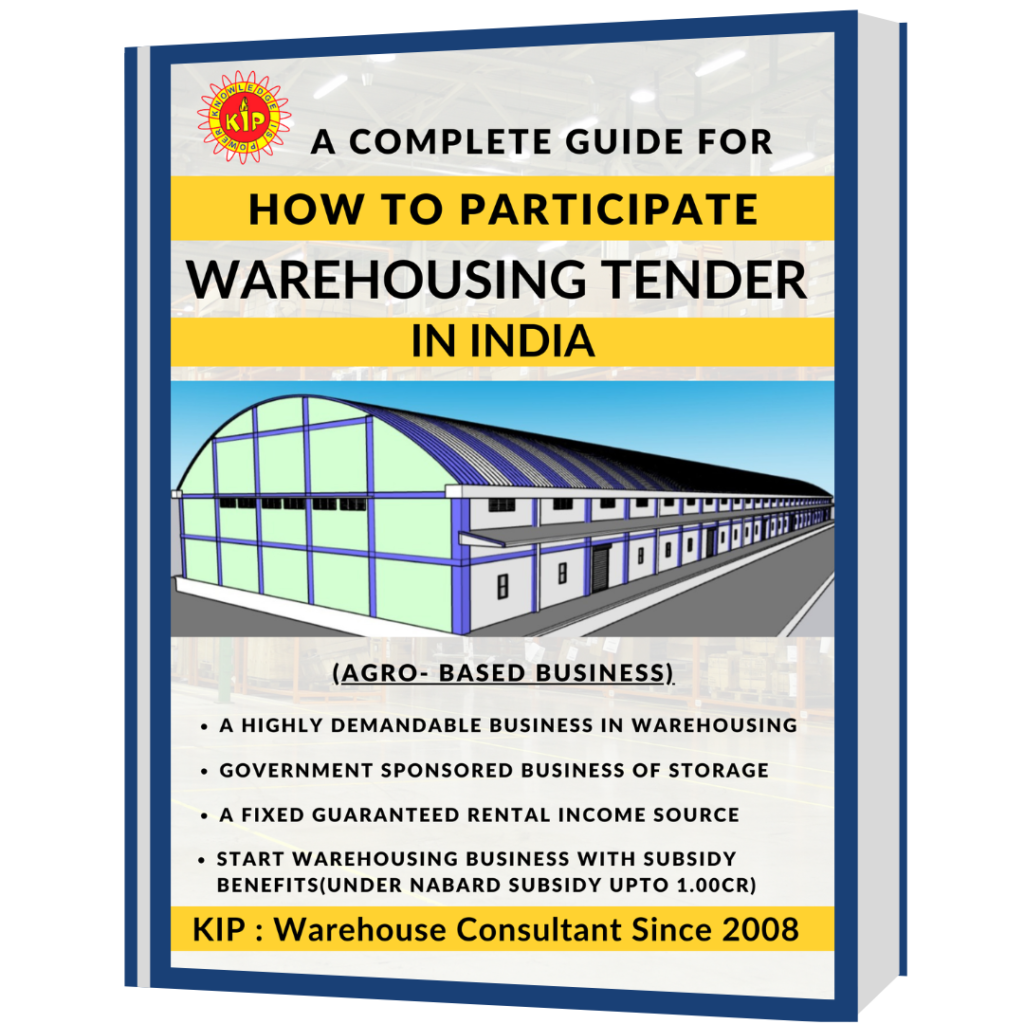
The warehousing sector in India is one of the fastest-growing opportunities for entrepreneurs, investors, and agri-business stakeholders. With rising demand for scientific storage of food grains and agro-based products, government agencies like FCI (Food Corporation of India), CWC (Central Warehousing Corporation), and State Warehousing Corporations are regularly issuing warehousing tenders in India. These tenders offer investors a chance to earn fixed guaranteed rental income while also leveraging NABARD subsidies and tax benefits.
KIP has been consistently guiding entrepreneurs in participating in warehousing tenders, helping them with project reports, subsidy assistance, and tender documentation.
Why Invest in Warehousing Tenders?
Fixed Guaranteed Rental Income – Warehousing tenders, especially under the PEG Scheme (Private Entrepreneur Guarantee), ensure long-term rental contracts with FCI and state agencies.
Government Support – Warehousing has been classified as an infrastructure sector, making it eligible for subsidies, tax benefits, and financing support.
High Demand & Low Supply – With increasing crop production and procurement, India requires modern warehouses to reduce wastage.
Risk-Free Returns – Since rental income is guaranteed by government bodies, it offers stable and secure earnings.
Government Subsidies & Support
1. NABARD Subsidy
The National Bank for Agriculture and Rural Development (NABARD) offers subsidy support for agro-based warehouses. Subsidy percentages may vary by state but typically range between 15% to 33% of project cost.
2. PEG Scheme
The PEG Scheme is a flagship initiative by FCI to promote private investment in warehousing. Entrepreneurs can construct warehouses and lease them to FCI under fixed rental contracts.
3. Silo Projects
With the modernization of food grain storage, silo projects are gaining traction. These advanced storage systems also fall under subsidy and tender support schemes.
4. Tax Benefits
Investors can claim tax deductions under Section 35AD of the Income Tax Act, which allows 100% deduction of capital expenditure on setting up a warehouse facility.
Eligibility to Apply for Warehousing Tenders
I. Land-Related Norms and Ownership
Land Ownership – The participant already owns the land.
Registered Lease – Land is taken on a registered lease, usually valid for 10 to 13 years.
Intend to Acquire – Applicants may also participate by showing intent to acquire or lease land after tender allotment.
II. Suitability Criteria for Land
Location Proximity: Land must be 8–15 km from the nearest Anaaj Mandi (grain market) or railway station.
Road Connectivity: A minimum 22-foot-wide road must connect the land.
Hazard Avoidance: No petrol pumps, brick kilns, or plastic industries within 500 meters.
Electrical Hazards: No overhead high-voltage electricity wires (e.g., 11 KV lines).
Flood Zone Restrictions: Land must not be in low-lying or flood-prone areas.
Land Level: Preferred land should be at road level or higher.
Water Bodies: No water canals, drains, or streams running across or adjacent to the land.
III. Minimum Land and Capacity Requirements
Covered Godown:
Minimum capacity: 5,000 MT.
Land required: 2 acres for 5,000 MT.
Additional 1.7 acres for every extra 5,000 MT.
Silo Projects:
Spoke Model (Road-connected): Requires 4 acres for 25,000 MT.
Hub Model (Railway siding connected): Requires 15 acres for 25,000 MT.
IV. Net Worth Requirements
Silo Projects: Minimum 25% of the total project cost as net worth.
AMP (Asset Monetization Policy) Projects:
Up to 2,000 MT → ₹56 lakhs
Up to 5,000 MT → ₹1.4 crores
Up to 20,000 MT → ₹5.6 crores
V. Technical Bid Documentation
Land ownership/lease records
Applicant documents
Net worth verification
NOC (No Objection Certificate) from local land authority
How KIP Helps Participate in Warehousing Tenders
Preparation of Detailed Project Report (DPR)
Subsidy Viability Report (SVR) to check eligibility for NABARD or state-level subsidies
Tender Documentation & Filing support
Bank Financing & Loan Assistance
Step-by-step guidance from land identification to warehouse operations
Frequently Asked Questions (FAQs)
Q1: What drives warehousing tenders in India?
A shortage of 166 MMT in food grain storage creates a massive investment opportunity.
Q2: What’s the main financial benefit of this business?
A fixed guaranteed rental income, ensuring regular passive income.
Q3: Do I need to own land to apply?
Not always—you can use leased land (10–13 years).
Q4: What’s the max NABARD subsidy?
NABARD policies offer a maximum capital subsidy of ₹100 lakh for up to 5000 MT storage capacity.
Q5: Are net worth requirements mandatory?
No, except for Silo and AMP tenders, where 25% of project cost is required.
Q6: What are the key land suitability requirements?
The land should ideally be located within 8 to 15 km of the nearest grain market (Anaaj Mandi) or railway station, and must have road connectivity that is at least 22 feet wide.
Tags
#AgriBusinessIndia
#AgriInfrastructure
#AgriWarehousing
#AIFsubsidy
#AMPscheme
#BusinessGrowthIndia
#CWC
#FCI
#FixedRentalIncome
#FoodStorage
#GovernmentTender
#GuaranteedIncome
#IndiaAgri
#KIPConsultant
#LogisticsIndia
#MSPprocurement
#NABARDSubsidy
#PassiveIncomeIdeas
#PEGscheme
#PWSscheme
#RuralBusinessIndia
#SiloProject
#StorageSolutions
#SubsidyBenefits
#SWC
#WarehouseDevelopment
#WarehouseInvestment
#WarehousingBusiness
#WarehousingIndia
#WarehousingTender
Posted in
#Warehouse







 Home
Home  Whishlist
  Checkout
  Account