
 Biomass
  Warehouse
  Msme services
  Agro-Base Business
  Business Registration
  Electric Vehicle (EV)
  Physical Book
  Tender Updates

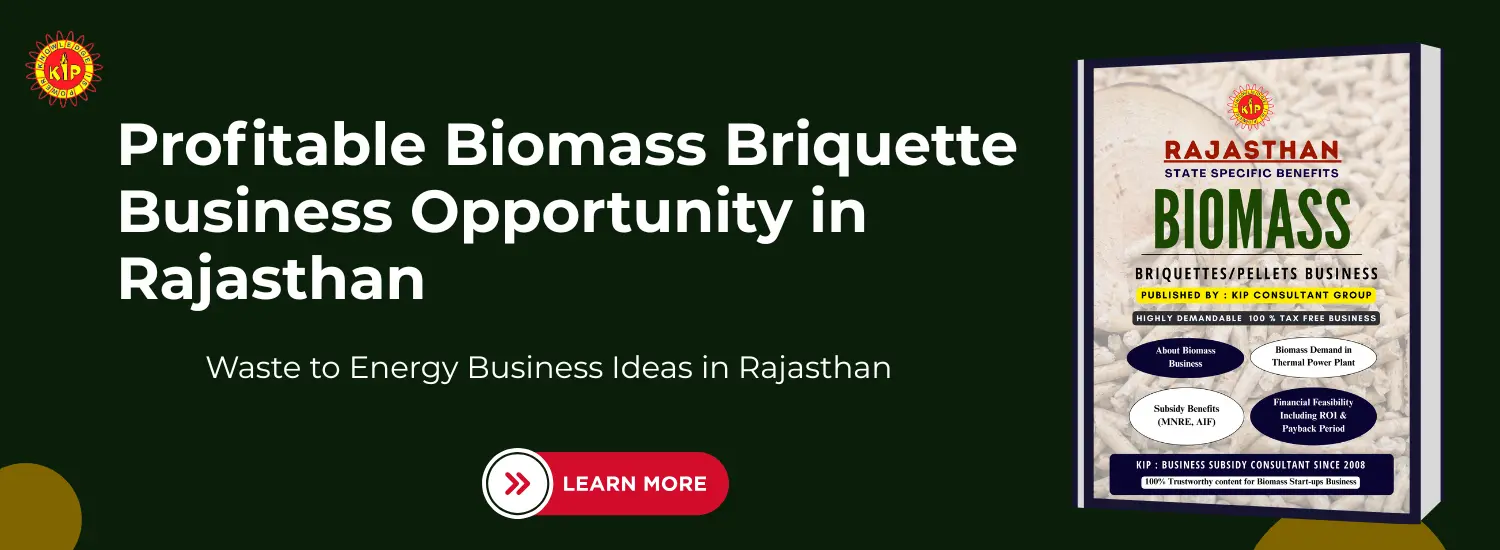
Profitable Biomass Briquette Business Opportunity in Rajasthan
The biomass industry in Rajasthan is rapidly growing due to increasing demand for renewable fuel and strong government support. With abundant agricultural waste and rising biomass utilization in thermal power plants, Rajasthan offers a profitable opportunity for entrepreneurs, MSMEs, and investors looking to enter the green energy sector.
This Rajasthan Biomass eBook provides practical guidance for setting up a biomass briquettes or pellets manufacturing business with detailed insights on investment, subsidy, ROI, and market demand. Inspired by industry-focused biomass business models and subsidy-based planning approaches.
Why Biomass Business in Rajasthan?
Rajasthan has strong biomass potential because of its large agricultural base and increasing industrial demand for eco-friendly fuel alternatives.
Key Advantages
- High availability of mustard husk, wheat straw, cotton stalks, bajra waste, and guar residue
- Growing demand from thermal power plants and industrial boilers
- Government-supported biomass co-firing policies
- Huge supply-demand gap in biomass fuel market
- Low competition with long-term growth opportunities
The biomass sector is becoming one of the fastest-growing waste-to-energy businesses in India.
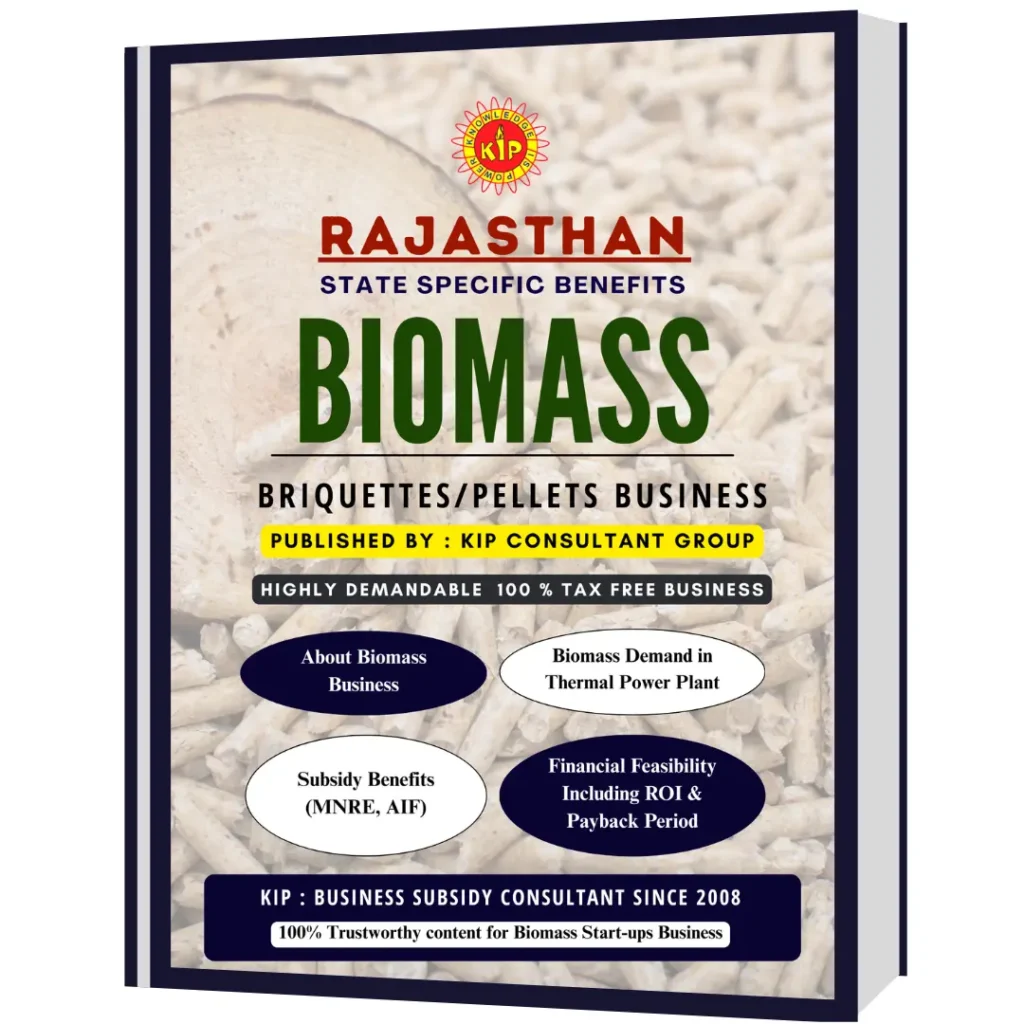
Rising Demand for Biomass Fuel
The Government of India has encouraged thermal power plants to use biomass pellets along with coal. This has increased the demand for biomass fuel across India.
Industries Using Biomass Fuel
- Thermal power plants
- Brick kilns
- Textile industries
- Food processing units
- Industrial boilers
- Cement industries
Biomass fuel is gaining popularity because it is cleaner, sustainable, and cost-effective compared to coal.
Government Subsidies for Biomass Business in Rajasthan
One of the biggest advantages of entering this sector is the availability of government subsidies and tax benefits.
1. MNRE Capital Subsidy
The Ministry of New and Renewable Energy (MNRE) provides financial assistance for biomass pellet manufacturing units.
Subsidy Structure
| Plant Type | Subsidy Benefit |
|---|---|
| Non-Torrefied Pellets | Up to ₹21 Lakhs per MTPH |
| Torrefied Pellets | Up to ₹42 Lakhs per MTPH |
Maximum Subsidy
- Up to ₹1.05 Crore for non-torrefied projects
- Up to ₹2.10 Crore for torrefied projects
The subsidy amount depends on project capacity and eligible machinery investment.
2. Tax Benefits Under Section 145
Biomass businesses processing biodegradable waste can receive 100% tax deduction on profits for 5 consecutive years under Section 145 of the Income Tax Act.
3. Agri Infrastructure Fund (AIF)
The Agriculture Infrastructure Fund provides financial support for agri-based infrastructure businesses.
Key Benefits
- 3% interest subvention on loans
- Loan support up to ₹2 Crore
- Credit guarantee benefits for eligible applicants
This scheme helps reduce the interest burden for biomass entrepreneurs.
4. PMEGP Subsidy
Small-scale biomass projects may also benefit from PMEGP subsidy schemes.
Benefits Include
- Subsidy up to 35% for eligible projects
- Support for new entrepreneurs and MSMEs
- Lower investment burden for small manufacturing units
Investment & Profit Potential in Biomass Business
A biomass pellet or briquette plant can become a highly profitable manufacturing business with proper planning and subsidy support.
Example Financial Insights
- Payback period can range between 3–4 years
- High ROI potential with stable market demand
- Long-term industrial and power plant buyers available
Profitability depends on raw material sourcing, production quality, and market linkage
What You Will Learn in the Rajasthan Biomass eBook
The eBook provides complete guidance for setting up and scaling a biomass business.
Topics Covered
- Biomass pellets vs briquettes
- Plant setup process
- Machinery planning
- Subsidy calculation
- DPR and bank loan guidance
- Raw material sourcing
- ROI and profitability analysis
- Tender participation guidance
- Market demand and buyer network
How KIP Can Help You
The KIP Team provides end-to-end support for biomass entrepreneurs.
Services Offered
- Subsidy consultancy support
- DPR and project report preparation
- Bank loan assistance
- Biomass business feasibility analysis
- Tender and compliance support
- Market linkage guidance
- Plant setup consultation
KIP helps entrepreneurs structure their projects to maximize subsidy benefits and improve long-term profitability.
Frequently Asked Questions (FAQs)
Q1: What is the maximum subsidy available?
Subsidy benefits can go up to ₹210 Lakhs depending on plant type and production capacity.
Q2: Is bank finance available?
Yes, projects can be self-funded or bank-funded with subsidy support.
Q3: What is the expected ROI?
A standard biomass project can achieve payback within approximately 3–4 years depending on capacity and operations.
Q4: What is the GST rate on biomass products?
Biomass products generally attract a reduced GST rate to support renewable energy businesses.
Q5: Who can start this business?
Entrepreneurs, farmers, MSMEs, startups, traders, and renewable energy investors can enter this sector successfully.
Tags
#Agricultural Waste Business
#AgriResidue
#biofuel business india
#Biomass Briquette Business
#Biomass Briquettes
#Biomass Business Rajasthan
#Biomass Entrepreneur Guide
#Biomass Fuel Manufacturing
#Biomass Fuel Plant
#Biomass Fuel Supply
#Biomass Funding
#Biomass Industry India
#Biomass Investment
#Biomass Loan Project
#Biomass Pellet Business
#biomass pellets
#biomass plant setup
#biomass project report
#biomass startup India
#Biomass Subsidy India
#BiomassBriquettes
#BiomassBusiness
#BiomassPellets
#Briquette Manufacturing Plant
#BusinessOpportunity
#CleanEnergy
#Eco Friendly Business
#Green Energy Business
#GreenEnergy
#Industrial Fuel Business
#InvestInIndia
#KIPFinancial
#MakeInIndia
#MNRE Subsidy
#MNRESubsidy
#Pellet Manufacturing Business
#Rajasthan Business Opportunity
#renewable energy business
#RenewableEnergy
#SubsidyBenefits
#Sustainable Energy Business
#TaxFreeBusiness
#thermal power plant fuel
#UttarPradesh
#waste to energy business
#WasteToEnergy
Posted in
#Biomass Briquettes and Pellets







 Home
Home  Whishlist
  Checkout
  Account