
 Biomass
  Warehouse
  Msme services
  Diary & Milk Processing
  Agro-Base Business
  Business Registration
  Tender Updates

Punjab offers a range of lucrative subsidies and government schemes to promote investment in the agri warehousing sector. Under the Integrated Logistics & Logistics Park Policy 2023, investors can avail benefits such as 100% SGST reimbursement, stamp duty exemption, and property tax relief. Additionally, central schemes like the Agriculture Infrastructure Fund (AIF) and NABARD Capital Subsidy provide financial assistance through interest subvention and capital grants. These initiatives aim to boost rural infrastructure, reduce post-harvest losses, and create profitable opportunities for farmers, entrepreneurs, and logistics companies establishing modern agri warehouses in Punjab.
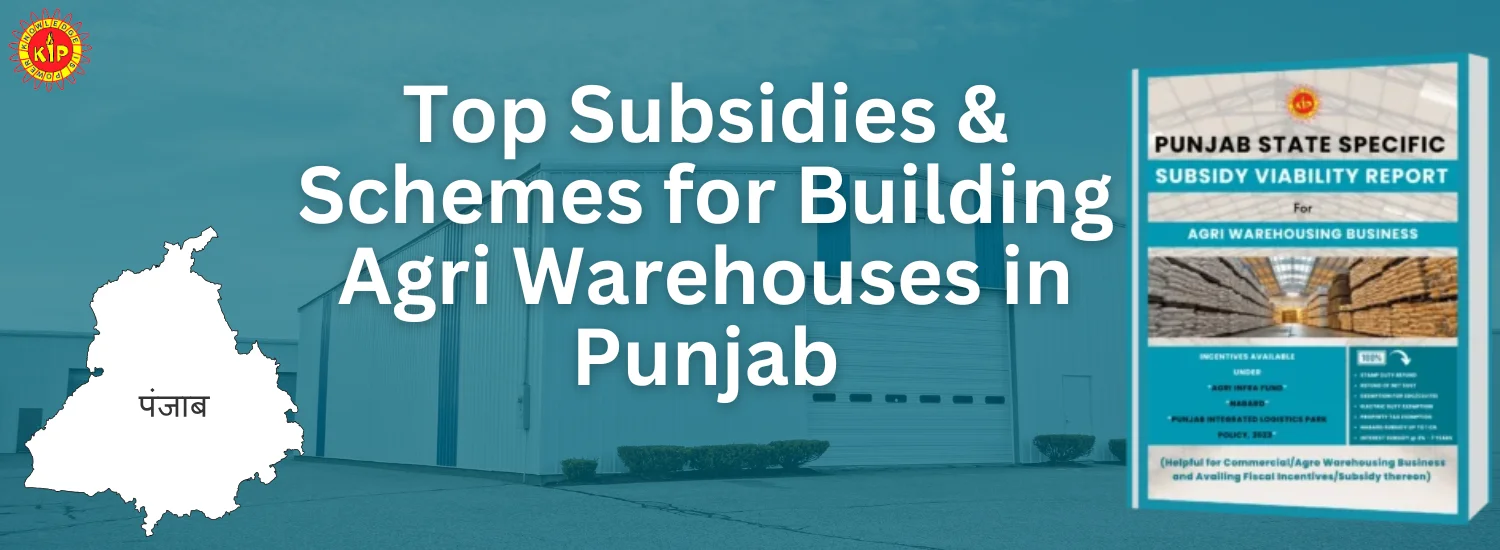
Top Subsidies & Schemes for Building Agri Warehouses in Punjab
Introduction: Why Punjab Leads in the Warehousing Sector
India’s warehousing sector is experiencing remarkable expansion, fueled by the implementation of GST, improved infrastructure connectivity, and increasing demand for efficient logistics solutions. Among India’s landlocked states, Punjab stands out as a logistics hub, having earned the “Achiever Status” in the LEADS 2023 Report for its well-developed logistics and industrial ecosystem.
For entrepreneurs, agripreneurs, and investors, Punjab presents a highly rewarding opportunity to establish or scale agri-warehousing and logistics facilities. The Integrated Logistics & Logistics Park Policy 2023 offers comprehensive fiscal incentives such as tax reimbursements, duty exemptions, and financial support for infrastructure development. Additionally, central schemes like the Agriculture Infrastructure Fund (AIF) andNABARD Capital Subsidy Scheme further enhance project viability through interest subvention and capital subsidies. Together, these state and central initiatives create a favorable environment for sustainable investments, strengthening Punjab’s role as a key logistics and agricultural warehousing destination in North India.

Key State Subsidies Under Punjab’s Integrated Logistics Policy
Punjab’s Integrated Logistics & Logistics Park Policy 2023 recognizes warehousing as a “Thrust Sector” and offers a wide range of fiscal incentives to attract private investment. These incentives are designed to reduce project costs and enhance long-term profitability for logistics and agri-warehousing enterprises.
Investors setting up warehouses in Punjab can avail:
100% SGST Reimbursement on intra-state sales for 10 years, capped at 125% of Fixed Capital Investment (FCI).
100% Exemption from Stamp Duty on the purchase or lease of land and buildings.
Electric Duty and Property Tax Exemption for 10 years from the date of commercial operations.
Full Exemption from CLU and EDC Fees, reducing upfront project development costs.
The Fixed Capital Investment (FCI) includes expenses on land, building, machinery, and equipment—though only up to 10% of land cost is considered eligible. These benefits collectively make Punjab one of the most attractive states for establishing modern warehousing and logistics hubs.
Central Government Schemes: AIF and NABARD Assistance
In addition to Punjab’s state-level incentives, investors can leverage central government financial schemes to further reduce project costs and enhance profitability. The two most beneficial programs for agri warehousing are the Agriculture Infrastructure Fund (AIF) and NABARD Capital Subsidy Scheme.
1. Agriculture Infrastructure Fund (AIF)
Provides 3% interest subvention per annum on eligible loans for agri-infrastructure projects.
Interest benefit available for up to 7 years on loans up to ₹2 crore.
Applicable for warehouses, silos, cold storages, and post-harvest infrastructure.
Encourages modern storage facilities to minimize post-harvest losses.
2. NABARD Capital Subsidy Scheme
Offers capital subsidy up to 25% (maximum ₹75 lakh per district) for general category promoters.
33.33% subsidy (up to ₹100 lakh) for FPOs, Women, SC/ST entrepreneurs, and cooperatives.
Eligible for storage capacity up to 5,000 MT per project.
Multiple district projects can claim subsidy separately, increasing total benefit potential.
Eligibility and Target Beneficiaries for Agri Warehousing Subsidies
The Punjab warehousing subsidy schemes are designed to support a wide range of stakeholders involved in agriculture, logistics, and rural infrastructure development. To qualify for these incentives, applicants must meet basic eligibility requirements under both state and central policies.
1. Eligibility Criteria
The unit must be registered under MSME/Udyam or as a valid business entity.
The project should involve agri or commercial warehousing, logistics, or cold storage activities.
The enterprise must maintain proper Fixed Capital Investment (FCI) records (land, building, machinery, equipment).
The investor should file regular Income Tax Returns (ITR) and comply with applicable laws.
Projects should be established within Punjab and adhere to CLU/EDC guidelines if applicable.
2. Target Beneficiaries
Farmers and Farmer Producer Organizations (FPOs)
Agro-based and Food Processing Units (e.g., rice mills, dal mills)
Traders, Wholesalers, and Commission Agents
3PL and Logistics Service Providers
Women Entrepreneurs, SC/ST Promoters, and Cooperatives
Private Investors and Developers seeking long-term rental or lease income
These groups can maximize returns by combining Punjab state incentives with AIF and NABARD subsidies, ensuring strong financial viability and sustainable growth.
How KIP Can Help You
Navigating multiple government subsidy schemes and financial policies can be complex — but that’s where KIP comes in. With years of expertise in warehousing, MSME, and agri-infrastructure advisory, KIP helps entrepreneurs, investors, and businesses unlock maximum benefits from both state and central government schemes.
Subsidy Viability Reports (SvR) to evaluate eligibility and total financial advantages.
Project Feasibility Studies covering technical, financial, and location analysis.
Documentation and Application Support for AIF, NABARD, and SGST reimbursement claims.
Business Model Development for warehousing, cold storage, and logistics projects.
End-to-End Consultancy — from project planning to subsidy disbursement.
Frequently Asked Questions (FAQs)
Q1: What is Punjab’s Integrated Logistics Policy 2023?
It’s a state policy offering fiscal incentives for warehousing and logistics projects, including tax and fee exemptions.
Q2: Who can apply for Punjab warehousing subsidies?
Farmers, FPOs, MSMEs, investors, and logistics companies involved in agri warehousing projects.
Q3: What is the subsidy rate under NABARD for warehouses?
25% for general category and 33.33% for FPOs, women, SC/ST entrepreneurs, and cooperatives.
Q4: How does the AIF scheme support warehouse projects?
It provides a 3% interest subvention on loans up to ₹2 crore for up to 7 years.
Q5: Are land and building costs eligible for subsidy?
Yes, but only up to 10% of total Fixed Capital Investment (FCI).
Q6: How long are the state incentives available?
Most benefits like SGST reimbursement and tax exemptions apply for 10 years.
Tags
#AgriBusiness
#AgriEntrepreneur
#AgroInfrastructure
#AIFScheme
#BusinessGrowth
#commercial warehouse for rent
#GovernmentSchemes
#IntegratedLogistics
#InvestmentOpportunities
#KIP4Business
#LogisticsGrowth
#LogisticsPolicy
#MakeIn
#MSMEIndia
#NABARDSubsidy
#PunjabIndustry
#PunjabWarehousing
#StartupIndia
#WarehouseInvestment
#WarehousingIndia
Posted in
#Subsidy Schemes & Policy







 Home
Home  Whishlist
  Checkout
  Account