

×

Fill the Form for New E-book Updates 2026

We Believe in Knowledge.... Because Knowledge is Power (KIP).

How to Start Warehouse Business in India – Cost, Profit, Subsidy & ROI

The warehouse business in India is emerging as one of the most profitable passive income opportunities for investors, landowners, and entrepreneurs. With rapid growth in e-commerce logistics, supply chain management, and agri-storage infrastructure, warehousing has become a high-return, low-maintenance investment model.

If you're looking to build long-term income, stable ROI, and leverage government-backed schemes, this business offers a powerful opportunity.

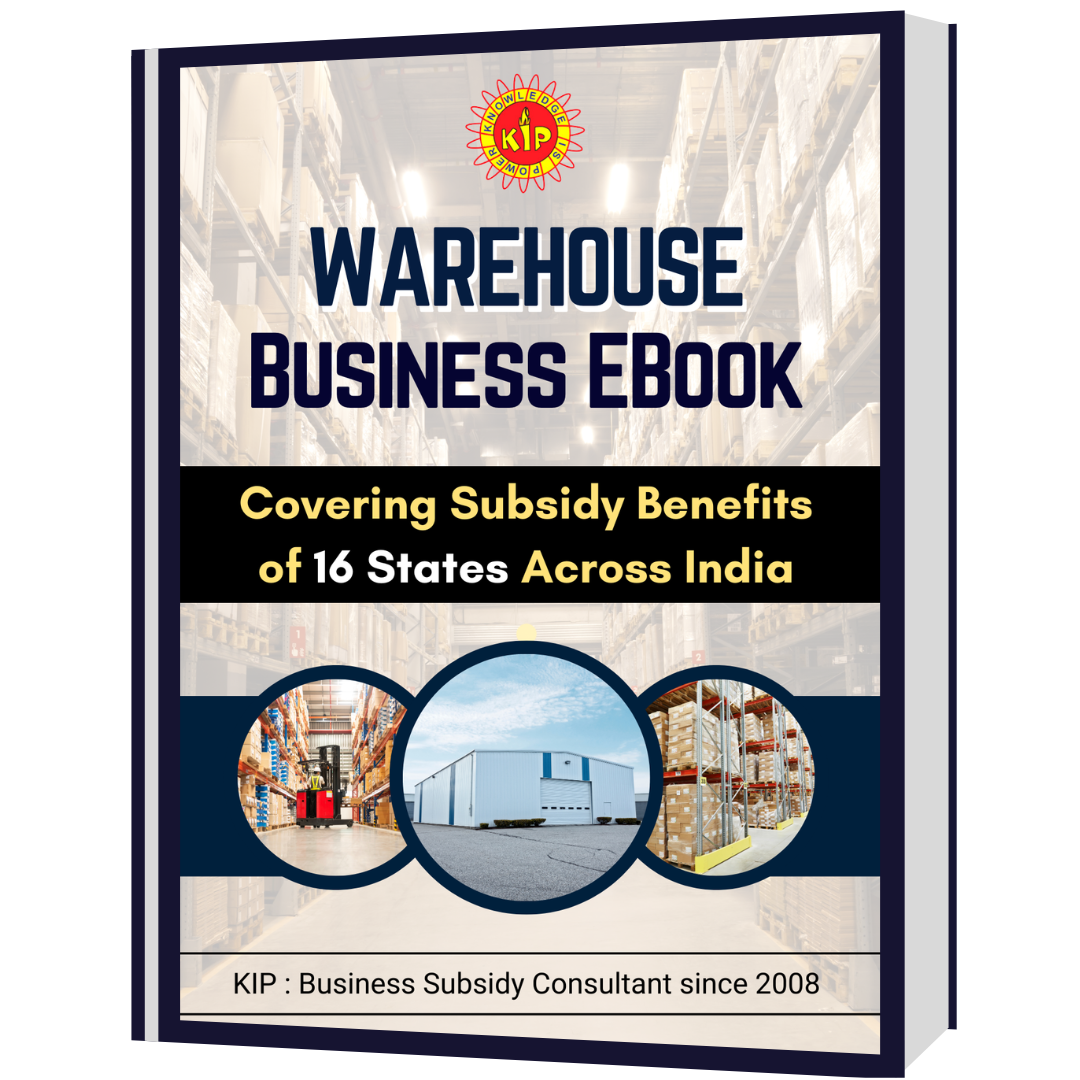
This blog gives you an overview—but if you want a complete roadmap with detailed calculations, subsidy guidance, and real project insights, our Warehouse Business eBook is designed to help you get started confidently
Why Warehouse Business is Booming in India

India is currently facing a significant storage infrastructure gap, creating strong demand for new warehouses.

 Estimated Demand Gap:

  • 50–70 million tonnes (agriculture storage)
  • 50–70 million sq ft (commercial warehousing)

Key Benefits:

  • Passive Income Source – Earn fixed rental income
  • High ROI Business – Better returns than traditional real estate
  • E-commerce Growth – Demand from platforms like Amazon & Flipkart
  • Low Risk Investment – Long-term lease contracts
  • Economic Impact – Reduces food wastage & improves logistics

Types of Warehouse Businesses in India

Agricultural Warehouses

  • Storage for grains, pulses, cold storage
  • Eligible for government subsidies & NABARD schemes
  • High demand in rural and semi-urban areas

Commercial Warehouses

  • Used for FMCG, e-commerce, industrial goods
  • Equipped with modern logistics technology
  • Ideal near highways, industrial hubs, metro cities

Government Subsidies for Warehouse Business

The government is actively supporting warehouse development under various schemes.

Key Schemes:

 Agriculture Infrastructure Fund (AIF)

  • 3% interest subsidy on loans up to ₹2 crore
  • Loan tenure up to 7 years

NABARD AMI Scheme

  • Capital subsidy of 25%–33.33%
  • Subsidy up to ₹75 lakh – ₹1 crore

State Government Benefits
Available in states like Haryana, Gujarat, Uttar Pradesh, Maharashtra:

  • Stamp duty exemption
  • Electricity subsidy
  • Capital investment incentives

Warehouse Business Cost, Profit, ROI, Tax Benefits & GST

  • Project Cost: Approx. ₹8 Crore (20,000 MT warehouse)
  • Investment: 25% own + 75% bank loan

Profit & ROI

  • Profit Margin: 24% – 53%
  • Payback: 6–7 years
  • Income: Fixed rent from long-term lease

 Tax & GST

  • Section 35AD: 100% tax deduction on construction cost (except land)
  • GST:
    • With services → No GST
    • Without services → 18% GST

Why You Should Read the Warehouse eBook

While this blog covers the basics, the Warehouse Business eBook provides:

  • Detailed project report & cost calculation
  •  Step-by-step setup process
  • Complete subsidy application guidance
  • Real-world profit & ROI case studies
  • Ready-to-use business strategies

How Can the KIP Team Help You?

The KIP Team provides complete support to help you successfully start and grow your warehouse business in India.

Our Support Includes:

  •  Project Planning
    Detailed guidance on warehouse size, cost estimation, and ROI analysis
  •  Subsidy Assistance
    Support in applying for NABARD, AIF, and state government schemes
  •  Location & Setup Guidance
    Help in selecting the right land and planning warehouse layout
  •  Documentation & DPR
    Preparation of Detailed Project Report (DPR) for bank loans and approvals
  • Loan & Financial Guidance
    Assistance in securing bank loans and structuring investment
  •  Business Strategy
    Guidance on finding clients, lease agreements, and maximizing income

Frequently Asked Questions (FAQs)

Q1: Why is warehouse business profitable in India?

The warehouse business in India is growing due to e-commerce, logistics, and retail expansion, offering passive income, stable ROI, and low-risk investment.

Q2: Agricultural vs Commercial warehouse – what’s the difference?
  • Agricultural warehouse: Stores grains, pulses; eligible for NABARD subsidy
  • Commercial warehouse: Used for FMCG, e-commerce, logistics, with advanced systems
Q3: What subsidies are available for warehouse business in India?
  • AIF scheme India: 3% interest subsidy up to ₹2 crore
  • NABARD warehouse scheme: 25%–33% capital subsidy (up to ₹1 crore)
Q4: How much land is required for warehouse in India?

A 20,000 MT warehouse needs approx. 7 acres land, depending on design and storage capacity.

Q5: Who are the clients for warehouse business?

Clients include e-commerce companies, FMCG brands, logistics firms, government agencies, and traders.

Select the fields to be shown. Others will be hidden. Drag and drop to rearrange the order.
  • Image
  • SKU
  • Rating
  • Price
  • Stock
  • Availability
  • Add to cart
  • Description
  • Content
  • Weight
  • Dimensions
  • Additional information
Click outside to hide the comparison bar
Compare