Fueling Business Growth, Unlocking Subsidy Benefits.
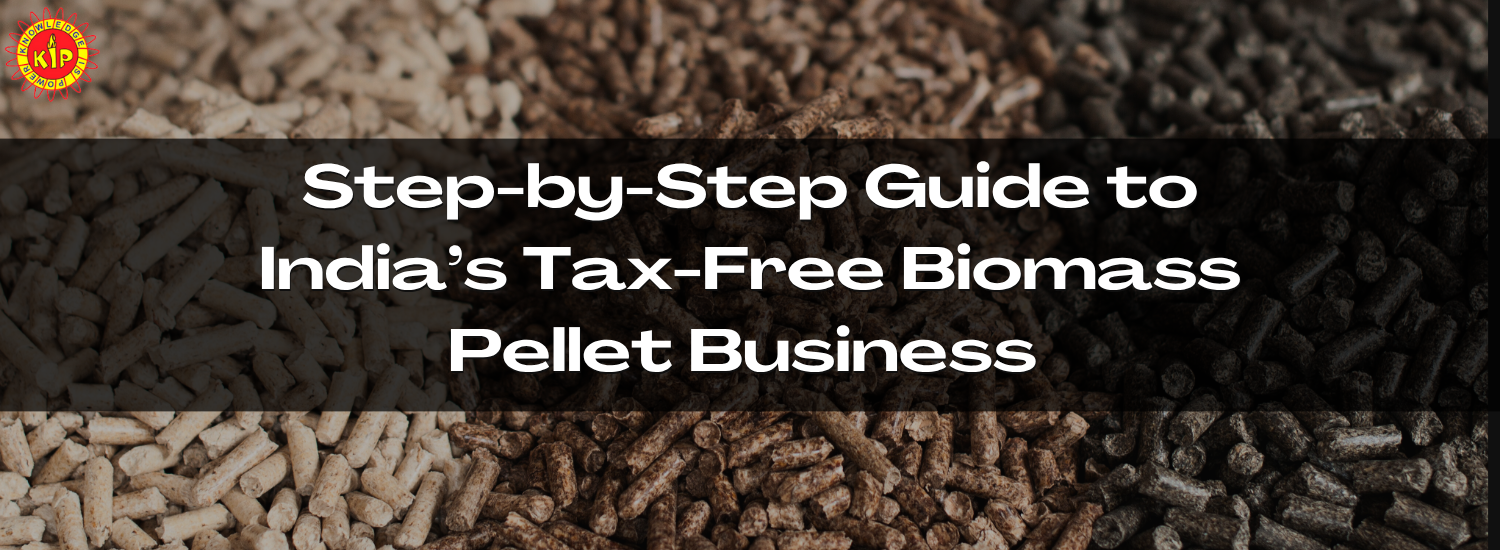
Step-by-Step Guide to India’s Tax-Free Biomass Pellet Business with ₹1.05 Crore Subsidy

Step-by-Step Guide to India’s Tax-Free Biomass Pellet Business with ₹1.05 Crore Subsidy

The Biomass Briquettes and Pellets business is one of the most promising and 100% tax-free opportunities in India today. Recognized as a strategic “Waste-to-Energy” sector by the Government of India and state governments, this venture not only contributes to green energy production but also supports the economy by managing agricultural residues efficiently.

KIP, with years of experience in guiding bio-energy projects, helps entrepreneurs navigate subsidies, incentives, and business setup in this high-demand sector.

Why Invest in Biomass Briquettes and Pellets?

1. Unprecedented Market Demand

The demand for biomass briquettes and pellets far exceeds India’s current production capacity. With an estimated daily demand of 95,000 tons and only 8,000–10,000 tons produced per day, opportunities are vast.

Government Mandate:
All coal-based thermal power plants must co-fire at least 5% biomass pellets or briquettes with coal. This ensures consistent demand from over 208+ thermal power plants. Industrial sectors such as paper mills, textile mills, food processing units, and brick kilns are also increasingly adopting biomass due to its environmental benefits and lower costs.

2. Biomass: A Cost-Effective Alternative to Coal

Biomass briquettes and pellets are not only eco-friendly but also economically advantageous.

FeatureCoalBiomass Briquettes/Pellets
Ash Content15–30%6–10%
PollutionHighLow
CostExpensiveLess expensive
HandlingRequires special facilitiesEasy to handle

While coal has a higher calorific value (5000–6000 KCAL/kg vs. biomass 3400–4000 KCAL/kg), biomass wins in lower pollution, ash reduction, cost-efficiency, and ease of handling.


3. 100% Income Tax Exemption (Section 80JJA)

Businesses manufacturing pellets or briquettes from agricultural or biodegradable waste are eligible for Section 80JJA of the Income Tax Act, 1961.

  • Provides 100% tax deduction on profits for five consecutive years.

  • Applies to net profit from the year the business starts its qualifying activity.

  • Encourages entrepreneurs to invest in environmentally sustainable practices.


4. MNRE Central Financial Assistance (CFA)

The Ministry of New and Renewable Energy (MNRE) provides CFA under the Biomass Programme, making the business highly attractive for investors.

Subsidy Details (Effective July 16, 2024):

Product TypeCFA per MTPHMax Subsidy (for 5 MTPH)
Biomass Briquettes₹9.0 Lakh₹45 Lakh
Non-Torrefied Pellets₹21.0 Lakh₹1.05 Crore
Torrefied Pellets₹42.0 Lakh₹2.10 Crore

Eligibility:

  • Biomass must be produced using agro-residues, such as crop residue, forestry waste, bamboo, horticultural residue, or wood chips.

  • Industrial waste, municipal solid waste, black liquor, or press mud are not eligible.

Additional Financial Benefits via Agri Infra Fund (AIF)

Beyond MNRE incentives, entrepreneurs can benefit from the Agri Infra Fund implemented by the Ministry of Agriculture and Farmers Welfare.

  • Interest Subsidy: 3% per year on loans up to ₹2 Crore, for up to 7 years, potentially saving ₹30–35 Lakh for a 2 TPH plant.

  • Collateral-Free Funding: 100% refund of CGTMSE cover fee for loans up to ₹2 Crore.

Frequently Asked Questions (FAQs)

Q1: What is the main purpose of this business?
To convert agricultural and biodegradable waste into renewable energy through briquettes and pellets.
Q2: Is income tax applicable on profits?
No, profits are 100% tax-exempt for five years under Section 80JJA.
Q3: Which raw materials are eligible for production?
Agro-residues like crop residue, forest residue, bamboo, horticultural residue, and wood chips.
Q4: What is the difference between torrefied and non-torrefied pellets?
Torrefied pellets are processed at high temperatures (300–350°C), giving higher energy density and lower moisture. Non-torrefied pellets have slightly higher moisture but are cheaper to produce.
Q5: Can small projects avail PMEGP benefits?
Yes, smaller projects (up to 2 TPH) may qualify for PMEGP subsidies up to 35% of the project cost.

Select the fields to be shown. Others will be hidden. Drag and drop to rearrange the order.
  • Image
  • SKU
  • Rating
  • Price
  • Stock
  • Availability
  • Add to cart
  • Description
  • Content
  • Weight
  • Dimensions
  • Additional information
Click outside to hide the comparison bar
Compare

Suggestion Box

We value your ideas and feedback!