


Fueling Business Growth, Unlocking Subsidy Benefits.
How to Claim Telangana Commercial Warehouse Subsidies Easily

How to Claim Telangana Commercial Warehouse Subsidies Easily

Claiming Telangana’s commercial warehouse subsidies is simpler when investors understand the key eligibility rules, credit-linked requirements, and documentation process under the Telangana State Logistics Policy 2021–26. The state offers attractive capital and interest subsidies for warehouses located in both non-tribal and tribal zones, along with additional benefits for quality and safety systems.

To claim these incentives smoothly, businesses must ensure proper MSME registration, maintain accurate Fixed Capital Investment records, and apply through the official government portal after commercial operations begin. With the right planning and compliance, investors can significantly reduce project costs and maximize long-term returns.
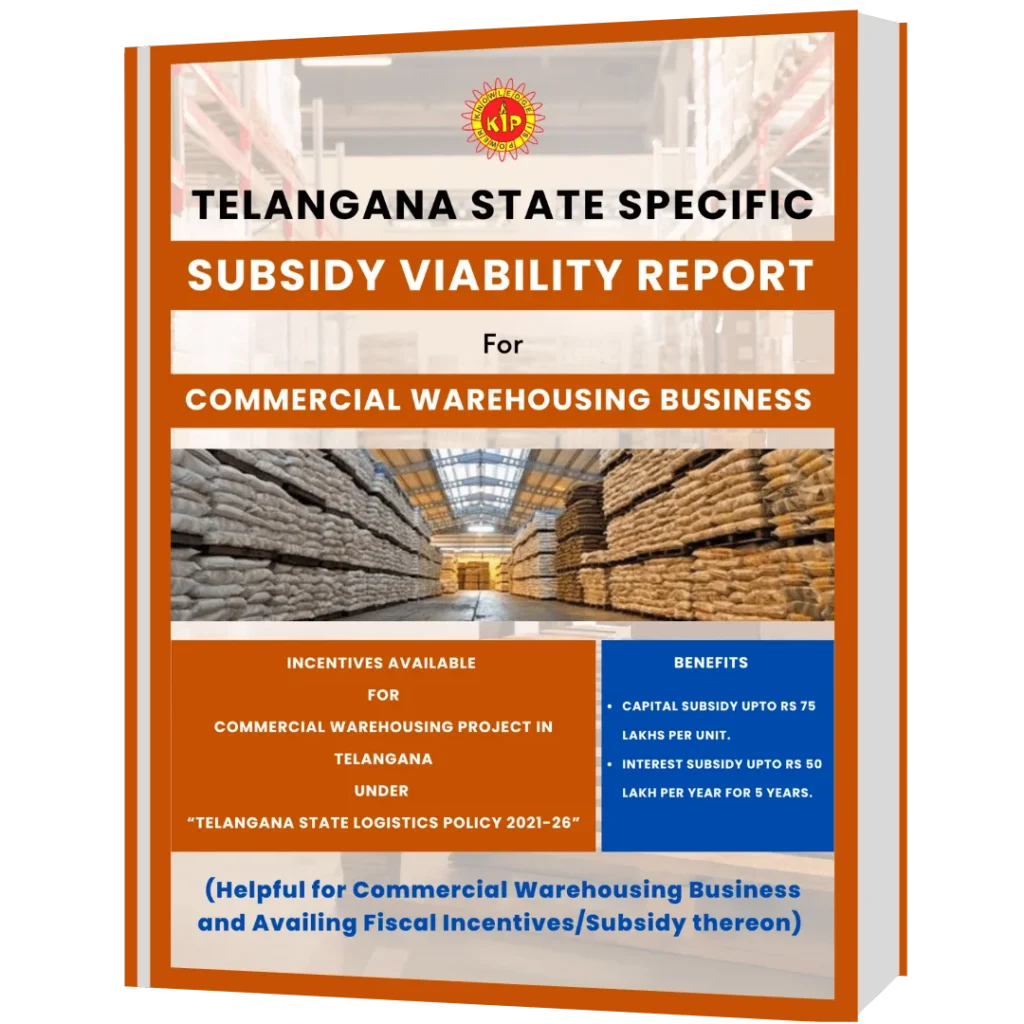
Introduction – Why Telangana is a High-Potential Warehousing

Telangana is quickly emerging as one of India’s most promising destinations for commercial warehousing, driven by a powerful combination of strategic location, progressive policies, and robust infrastructure development. Situated at the geographical center of India, the state provides unmatched connectivity to major consumption markets, making it ideal for storage, distribution, and logistics operations.

The Telangana Government’s proactive approach—especially through the Logistics Policy 2021–26—has further strengthened the state’s position by offering attractive capital and interest subsidies, simplified procedures, and investor-friendly reforms. With consistent “Achiever” status in national logistics rankings, Telangana has demonstrated its efficiency and commitment to building a world-class logistics ecosystem.

Rapid highway expansion, industrial parks, and the growing e-commerce footprint have fueled strong demand for modern, compliant warehouses. For investors, entrepreneurs, and logistics companies, Telangana presents a rare opportunity to establish profitable warehousing assets while benefiting from substantial fiscal support and low operational hurdles.

India’s Booming Demand for Organized Warehousing

Several macro shifts are pushing the demand for modern warehouses:

1. GST & Unified Taxation

GST has eliminated multi-state tax complexities and encouraged centralized storage, making large-format warehouses the industry standard.

2. Infrastructure & E-Commerce Growth

Better highways, logistics corridors, and the surge of Amazon/Flipkart-style e-commerce have created unprecedented demand for storage, distribution, and fulfillment centers.

3. Telangana’s Strategic Advantage

Telangana consistently ranks among top-performing logistics states (LEADS 2023 Achiever Status). Its improved connectivity and business-friendly policies make it a natural hub for warehousing investments.

Key Incentives Under the Telangana State Logistics Policy 2021–26

The policy offers a mix of capital subsidies, interest reimbursement, and additional financial assistance. Most benefits are credit-linked, meaning the warehouse must be constructed using a bank loan.

A. Capital Subsidy

  • Non-Tribal Zones: 10% of FCI | Max ₹50 Lakhs/unit

  • Tribal Zones: 20% of FCI | Max ₹75 Lakhs/unit

  • Paid post-Commercial Operations (COO)

B. Interest Subsidy

  • Non-Tribal Zones: 35% of interest | Max ₹50 Lakhs/year | 3 years

  • Tribal Zones: 35% of interest | Max ₹50 Lakhs/year | 5 years

  • Must be within 20 km of tribal areas for extended benefits.

C. Additional Incentives

  • 50% reimbursement for ISO/QMS (up to ₹5 Lakhs)

  • 20% reimbursement for fire detection systems (up to ₹10 Lakhs)

Who Benefits & How to Maximize Incentives

Eligible Beneficiaries

  • Commercial/wholesale traders

  • Agro & food processing units

  • 3PL & logistics companies

  • Real estate developers & investors

  • E-commerce/online businesses

  • Banks offering term loans

Strategic Guidelines

  1. Verify policy eligibility before investment.

  2. Maintain accurate records of Fixed Capital Investment (FCI).

  3. Complete mandatory state registrations early.

  4. Ensure MSME registration is valid on project start date.

  5. Conduct a Subsidy Viability Report (SvR) to maximize benefits.

How KIP Can Help You

KIP brings end-to-end expertise in subsidy planning, financial structuring, and government-policy execution for warehousing projects. Our dedicated consulting team ensures that your investment is aligned with Telangana’s Logistics Policy requirements, helping you maximize fiscal benefits with zero compliance gaps.

Our Key Support Includes:

Frequently Asked Questions (FAQs)

Q1: Who can apply for Telangana warehousing subsidies?

Any investor, MSME, logistics firm, trader, 3PL, or e-commerce business setting up an eligible warehouse.

Q2: Is a bank loan compulsory?
Yes — capital and interest subsidies are credit-linked, so a construction loan is mandatory.
Q3: What are the benefits for tribal zone warehouses?

Higher capital subsidy (20%), longer interest subsidy (5 years), and reduced minimum capacity (10,000 sq. ft).

Q4: When is the subsidy released?

After Commercial Operation (COO) and submission of required documents.

Q5: What documents are required?

MSME registration, loan papers, invoices, FCI details, COO proof, and filled state-portal forms.

Select the fields to be shown. Others will be hidden. Drag and drop to rearrange the order.
  • Image
  • SKU
  • Rating
  • Price
  • Stock
  • Availability
  • Add to cart
  • Description
  • Content
  • Weight
  • Dimensions
  • Additional information
Click outside to hide the comparison bar
Compare

Suggestion Box

We value your ideas and feedback!