

We Believe in Knowledge.... Because Knowledge is Power (KIP).
Biomass Briquettes and Pellets Business in Gujarat

Start a Profitable Biomass Manufacturing Unit in Gujarat

Gujarat has emerged as the No.1 destination for the biomass briquettes and pellets business in India. With strong agro-residue availability, thermal power plant demand, and unmatched government subsidies, the state offers a low-risk, high-ROI green energy business opportunity.

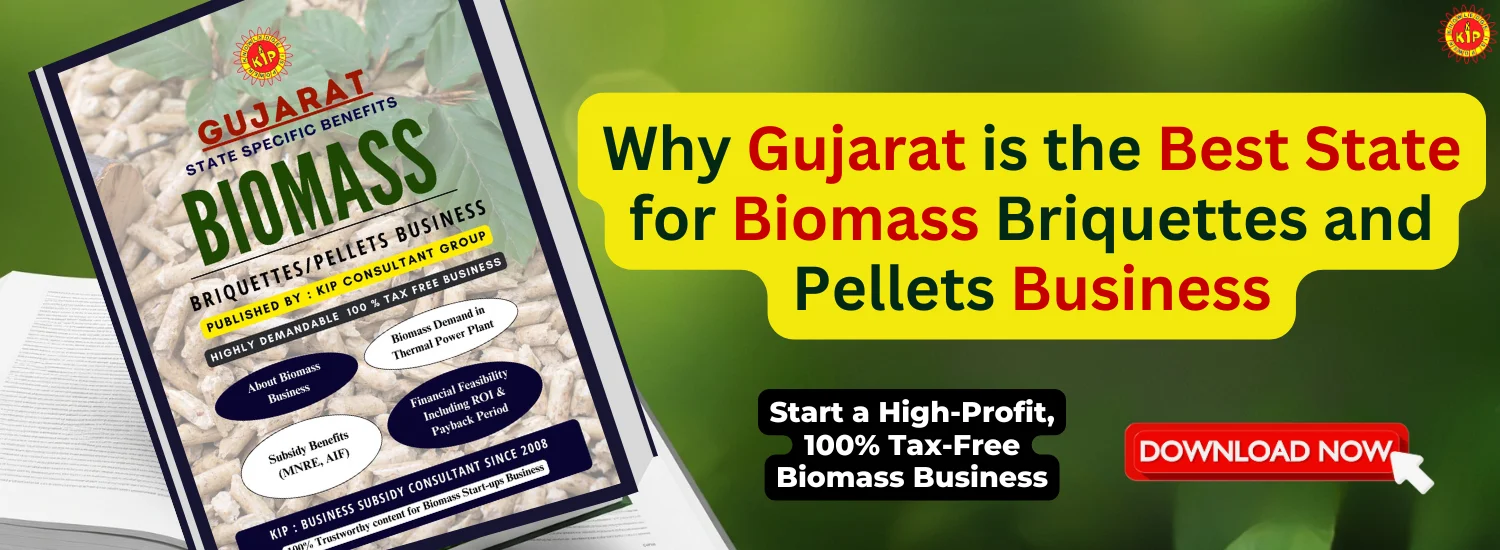
The Gujarat Biomass Briquettes & Pellets Business eBook is a practical, step-by-step guide designed for entrepreneurs, MSMEs, and investors who want to enter the waste-to-energy sector with clarity, compliance, and confidence.

This blog explains why this eBook is essential, what it covers, and how it helps you build a successful biomass pellet or briquette manufacturing unit in Gujarat.

Why Gujarat is the Best State for Biomass Business

Gujarat’s agro-industrial ecosystem makes it ideal for biomass fuel manufacturing. The state produces massive quantities of agricultural residues that are otherwise burned or wasted.

Key Advantages of Gujarat for Biomass Business

  • Abundant raw material: cotton stalks, groundnut shells, castor husk, bagasse

  • Strong industrial demand from power plants, cement, textile & FMCG units

  • Excellent road, port & logistics connectivity

  • Supportive Gujarat MSME and renewable energy policies

India’s biomass demand is nearly 95,000 tons per day, while production is less than 10,000 tons per day, creating a huge supply-demand gap. Gujarat stands at the center of this opportunity.

This eBook explains district-wise raw material availability, plant location strategy, and demand mapping for Gujarat

Biomass Briquettes vs Biomass Pellets

Understanding the difference between biomass briquettes manufacturing and biomass pellets manufacturing is critical before investing.

Biomass Briquettes Business

  • Used in boilers and industrial furnaces

  • Lower investment cost

  • Ideal for local industrial clusters

Biomass Pellets Business

  • Used by thermal power plants

  • Mandatory blending with coal (5%–7%)

  • Long-term government demand

  • Higher scalability and export potential

Types of Biomass Pellets

  • Non-Torrefied Pellets – high demand in PSU tenders

  • Torrefied Pellets – higher calorific value, premium pricing

The Gujarat Biomass eBook provides a comparison chart, cost structure, machinery details, and profit margins for both models.

Government Subsidies, MNRE Grants & Tax Benefits

One of the biggest reasons biomass manufacturing is booming is government financial support.

Central Government Incentives

  • Income Tax Exemption (Section 80JJA) – 100% profit deduction for 5 years

  • MNRE Capital Subsidy

    • ₹21 lakh per MTPH – Non-torrefied pellets

    • ₹42 lakh per MTPH – Torrefied pellets

  • Agri Infrastructure Fund (AIF)

    • 3% interest subvention

    • Loans up to ₹2 crore for 7 years

  • PMEGP Subsidy

    • Up to 35% subsidy for small projects

Gujarat State Subsidies 

  • Capital subsidy up to ₹35 lakh

  • Interest subsidy 5%–7%

  • 100% SGST reimbursement for 10 years

  • EPF reimbursement & electricity duty exemption

This eBook includes eligibility criteria, subsidy calculation examples, and application flowcharts.

Project Cost, Profit Margin & ROI of Biomass Business

A major highlight of the Gujarat Biomass eBook is real financial feasibility.

Example: 2 TPH Biomass Pellet Plant

  • Project Cost: ₹2.8 crore

  • Payback Period: 3–3.5 years

  • 7-Year IRR: 44%+

  • Stable cash flow due to long-term demand

Key Financial Topics Covered in the eBook

  • Land & machinery cost

  • Working capital planning

  • Bank loan & DPR format

  • Monthly profit estimation

  • Break-even analysis

Risk Management, Raw Material Planning & Tender Success

Every biomass entrepreneur faces challenges—but smart planning reduces risk.

Key Risks Covered in the eBook

  • Seasonal raw material availability

  • Moisture & GCV quality control

  • Storage and fire safety

  • Price fluctuations

Practical Solutions Provided

  • 3–4 months raw material buffer strategy

  • Biomass aggregator contracts

  • Power plant tender compliance

  • Quality specification checklists

The Gujarat Biomass eBook also includes tender readiness tips and compliance guidelines.

How Can the KIP Team Help You?

  • Project planning & feasibility for biomass briquettes and pellets

  • DPR preparation & bank loan support

  • MNRE, AIF, PMEGP & Gujarat MSME subsidy assistance

  • Statutory approvals & compliance guidance

  • Power plant tender & market linkage support

  • Post-setup growth and expansion advisory

Frequently Asked Questions (FAQs)

Q1: Who should buy this eBook?

Entrepreneurs, MSMEs, investors, and agri-business owners planning to enter the biomass or waste-to-energy sector.

Q2: Does the eBook cover government subsidies?

Yes, it explains MNRE subsidy, AIF interest benefit, PMEGP, Gujarat MSME incentives, and tax benefits.

Q3: Is biomass pellets business profitable in Gujarat?

Yes, due to high demand, coal-blending mandates, and strong ROI potential.

Q4: Does the eBook include project cost and ROI details?

Yes, it includes plant cost, profit margins, payback period, and IRR examples.

Q5: Will it help with bank loans and DPR preparation?

Yes, it provides bank-ready guidance and financial planning support.

Post a comment

Your email address will not be published.

Select the fields to be shown. Others will be hidden. Drag and drop to rearrange the order.
  • Image
  • SKU
  • Rating
  • Price
  • Stock
  • Availability
  • Add to cart
  • Description
  • Content
  • Weight
  • Dimensions
  • Additional information
Click outside to hide the comparison bar
Compare